
Dáša and Béla, you are both credited as directors of the film. How did you work together on it, and how did the fact that Béla is also a visual artist – a photographer – and is in the process of organising an exhibition of his work, influence your collaboration? To what extent did Béla himself shape the film as it was being made?
Béla: I wanted to be the film’s co-director. At the start, Dáša and I didn’t really know each other yet, and as a Roma artist and journalist it was important to me to have a say in those parts of the filmmaking where the line between a stereotypical portrayal of Roma and one free of stereotypes is very thin. In the end we found the balance, and we worked together very well.
How did you meet, and how did the idea of making this film come about?
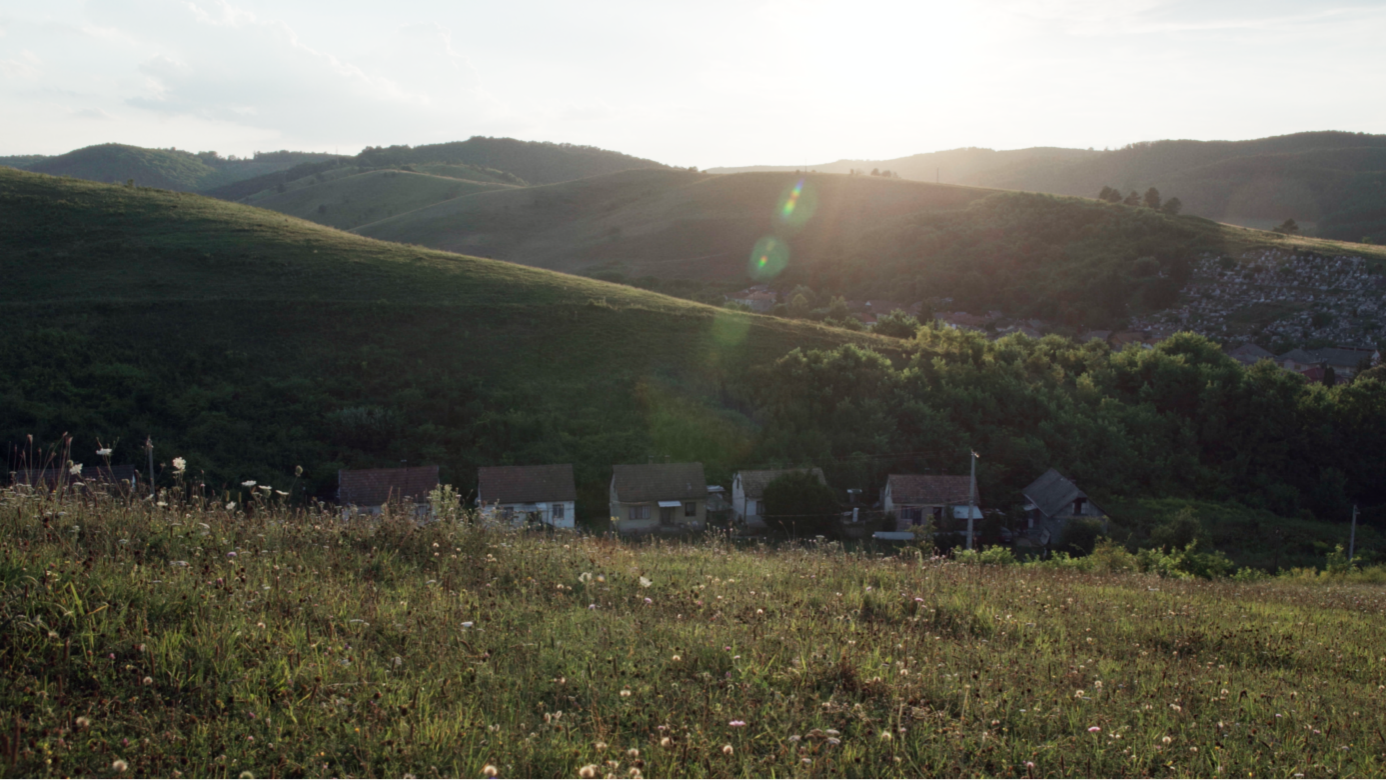
Béla: If I remember rightly, we met in 2023 at Trans Pride in Brighton. Dáša was filming with a gay Irish Traveller man, and I was there photographing the event with the Traveller Pride group, so we had a shared interest. Later, my plan for an exhibition in Borsodnádasd and my dreams came up in conversation, and Dáša suggested filming all of it. That’s how it started.
Dáša: We met during Trans Pride in Brighton. Bela was photographing a Traveller Pride - a self-help group for queer Gypsy, Roma and Travellers. I was doing a research shoot with a queer Irish traveller. Bela told me about his past as a news presenter in Hungary, which truly intrigued me. Two years later, Bela told me about his dream to make an exhibition in his hometown. That is when our collaboration and an idea for a film started.
Béla, in your work, you are usually the one standing behind the camera, whereas in this film, your own deeply personal story unfolds in front of it. How do you feel about being the focus of attention this time, along with your relatives and the communities you belong to – groups that are often marginalised in society? How do you think they feel about being the focus of this attention?
Béla: I worked in television news for many years, and towards the end of my TV career I was also a presenter, so being in front of the camera isn’t that far from me. The biggest challenge was still to remain authentically myself while the camera was rolling – not to play “Béla Váradi”, not to play a role, but simply to be myself. I think I managed that, although it was made harder by the fact that, as a director, I also had to keep an eye on my own behaviour, and at the same time I had to make the exhibition happen. I think my relatives and the people I know enjoyed being in front of the camera. So much attention had never been directed at them before, and they really liked it.
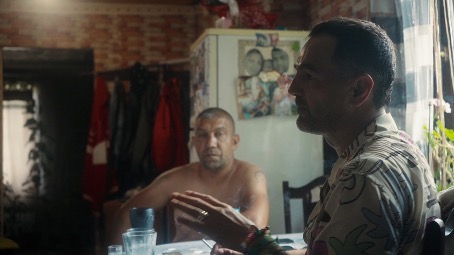
At the beginning of the film, we learn that Béla wants to return to his hometown because of a recurring dream in which his friends and family are waiting for him at home, gathered around a table. At the end of the film, we see Béla in precisely this situation: the people of Borsodnádasd are sharing a meal at the community centre after the opening of the exhibition. What does this framing mean? Did you manage to achieve the „goal” you had set out to „accomplish”? Is it possible to return to a community after such a long absence – whether from the perspective of the person returning or that of the community itself?
Béla: It was never the goal to film my dream exactly, only to come close to it. What mattered was the feeling, the gesture: hosting my family and friends, sharing an experience together, and being free to be who I am in front of them, without inhibitions. All in all, that is what happened, so I’m grateful for the whole production. In a way my dream came true, and even more than that: I reconnected with my family, and they with me. I owe that to the film as well.
How do you think making the film helped with confronting the past, the present, questions of identity and community, as they emerge in it? Does the film merely document these processes in the lives of Béla and his home community, or does it also play a part in shaping them?
Béla: I had already confronted my past before the film was made, but making the film gave that whole process a shape. It isn’t easy to go back to your home village when you have become a completely different person, because neither the locals nor you are prepared for what you will bring out in each other. But my intention was clear: to face who I was back then and to redefine myself. I have to say the film also shaped the process. With a camera behind you, the situation is completely different. The camera amplified my position and what I wanted to say, and it was also because of the camera that people’s reactions to me became stronger, sometimes negative, sometimes positive. So it was quite intense.
Do you believe that making your film, or films like it, can help overcome prejudices against queer people and Roma people in Hungarian society – or in any other society? Or does the question of social impact stay more in the background compared to the personal desire for artistic self-expression?
Béla: No, I don’t believe this film will change anything. That isn’t pessimism, it’s a fact. For one thing, unfortunately it doesn’t reach its target audience; for another, it’s only a drop in the ocean. Even so, it’s very important that it was made, because the struggle itself is what matters, and that changes far more than the film does. The act of making it, the fact that we filmed it, did much more than the finished film.
Dáša: As a filmmaker, I always want to spark conversation beyond the film circuit. I truly believe in the power of cinema to create empathy and to contribute towards change. To however effect socio-political change the pressure has to be long-term come from various sides.
The film is set in 2024, in a Hungary where, as is mentioned in the film, even representing homosexuality can be against the law, although laws are rarely needed to enforce rejection and hostility. How open were the local community and the management of the community centre to Béla's ideas? Did this come with any difficulties or forced compromises, either in organising the exhibition or in making the film?
Béla: In rural Hungary people don’t talk about sensitive things, they simply don’t. There are many taboos, and being gay is one of them. In Borsodnádasd, me being gay is an open secret, but also a taboo. The fact that I was creating an exhibition as an openly gay man, while we were also making a documentary about it, sounded interesting enough to break through certain walls. Funding, for example, was not a problem: the mayor paid for everything out of his own pocket. But behind the scenes there was whispering about who I thought I was to do something like this, and why I was doing it at all. My attitude was that I don’t care what people say behind my back, because they say it behind my back, so it doesn’t count. As long as there are people who hate you, you can be sure you’re doing something right. It didn’t feel good, but I wasn’t worried. After all, both the film and the exhibition were made in rural Hungary while the Orbán regime was raging.
Béla, in the film, the exhibition you organised in your native village created an opportunity for you to reconnect with a community in which your sense of belonging had not necessarily been taken for granted. You have now also opened an exhibition in Budapest: it is almost as if the story told in the film were continuing in real life, with this process of confrontation extending to a new and broader context. How do you see this development? To what extent do you consider the Budapest exhibition a continuation of the story begun in the film – a story about embracing one's identity, returning home and belonging to a community?
Béla: No, it wasn’t the film that gave me the opportunity to reconnect; it was just one of the tools for what I wanted to achieve. That was my plan even without the film: the exhibition, and a closer relationship with my family, my friends and the whole community. The Budapest exhibition is a completely different layer of my life, and I have to say it isn’t a continuation of the film but a continuation of my life – even if it will indeed be part of the planned feature-length documentary. It is about my artistic career, not about returning home; I let go of that idea long ago. The Budapest exhibition isn’t even a milestone, more a missing piece of the puzzle in my career, one whose place had been there for a long time.
The interview is part of the UniVerzió program.